Walking for Weight Loss: 5 Benefits of Walking Every Day

Walking is one of the simplest ways to become more active — and you don’t need a gym membership to get started. Whether you walk around your neighborhood, through a park, on a treadmill, or during your lunch break, regular walking can become an important part of a healthy weight-management routine.
The key is consistency.
Walking for weight loss alone isn’t a magic solution for weight loss, but it offers substantial benefits. When combined with nutritious eating, appropriate portions, adequate sleep, stress management, and other healthy habits, walking for weight loss can help you create a more active lifestyle that is easier to maintain over time. Let’s look at 5 benefits of walking for weight loss every day and how you can make walking for weight loss part of your weight-loss routine.
1. Walking Helps You Burn More Calories
Incorporating walking for weight loss into your daily routine can enhance your overall health and fitness level. One of the most straightforward benefits of walking is that it increases the amount of energy your body uses. Brisk walking is considered a moderate-intensity aerobic activity. Regular physical activity can increase the calories you use, and when combined with appropriate food intake, it can contribute to the calorie deficit needed for weight loss. That doesn’t mean you need to walk for hours every day. A short walk is still movement. Walking for weight loss not only helps in burning calories but also allows you to enjoy nature and clear your mind.
You might start with:
- a 10-minute walk after breakfast
- a 15-minute walk during your lunch break
- a 20-minute evening walk
- walking to nearby destinations instead of driving
- taking the stairs when practical
If you currently do very little activity, starting small can make the habit easier to maintain. NIDDK notes that even shorter periods of activity can be accumulated throughout the day.
2. Walking Can Help You Build a More Active Lifestyle
Consider how walking for weight loss can fit into other parts of your day, as simple adjustments lead to significant changes. Weight management isn’t only about one workout. It’s also about what you do throughout the entire day. Walking provides an easy way to reduce sedentary time and add more movement to your normal routine.
Instead of thinking:
Making walking for weight loss a priority can transform your daily habits and mindset.
“I need to exercise.”
Try thinking:
“How can I move a little more today?”
For example:
Morning: 10-minute walk
Lunch: 10–15-minute walk
Evening: 20–30-minute walk
Those small sessions can add up. And because walking doesn’t require complicated equipment or a specialized facility, many people find it easier to incorporate into everyday life. NIDDK specifically describes walking as an activity that can be done almost anywhere and recommends shorter walks when a longer session isn’t practical.
3. Walking Supports Heart and Overall Health
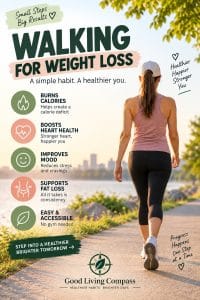
Walking isn’t only about the number on the scale. Regular physical activity provides health benefits that exist independently of weight loss. According to the CDC, regular physical activity can improve sleep, support brain health, strengthen bones and muscles, and reduce the risk of several chronic conditions, including cardiovascular disease and type 2 diabetes. Walking can also contribute to:
- better cardiovascular fitness
- stronger muscles and bones
- improved physical function
- better sleep
- improved mood
- reduced sedentary time
This is an important reason to think about walking as part of a healthier lifestyle, rather than simply as a tool for losing weight. Integrating walking for weight loss into your lifestyle can offer long-term health benefits.
4. Walking Can Support Your Mood and Help Reduce Stress
Your weight-loss journey isn’t only physical. Stress, emotions and daily routines can influence eating behavior and your ability to stick with healthy habits. Physical activity can support mental well-being. NIDDK notes that regular activity may improve mood and reduce stress, while the WHO highlights benefits for mental health and overall well-being. A walk can therefore become more than exercise. It can be your:
- quiet thinking time
- break from your computer
- opportunity to listen to music
- time outdoors
- chance to catch up with a friend
- transition between work and home
Sometimes the best exercise habit is one that you actually enjoy. Walking for weight loss is not just about losing pounds; it’s about improving your overall wellness.
5. Walking Is Simple Enough to Make Consistency Easier
Challenge yourself to include walking for weight loss into your routine for effective results. This may be one of the biggest advantages of walking. You don’t necessarily need:
- expensive equipment
- a gym membership
- complicated workout programs
- advanced exercise skills
You mainly need a safe place to walk and comfortable footwear. The WHO recommends that adults get 150–300 minutes of moderate-intensity aerobic activity per week, with muscle-strengthening activities on at least two days per week. Brisk walking can count toward the aerobic activity target. That could look like:
30 minutes × 5 days
or:
20–25 minutes most days
You don’t have to start at the full target. If you’re currently inactive, gradually increasing your activity can be a more realistic approach. NIDDK also notes that some activity is better than none and recommends building up gradually.
How Fast Should You Walk?
You don’t need to turn every walk into a race. For moderate-intensity activity, your breathing and heart rate should increase, but you should still be able to talk. This is often called the talk test. A brisk walk is generally more intense than a leisurely stroll and can count as moderate-intensity aerobic activity. A simple progression could be:
Week 1: 10–15 minutes of comfortable walking
Week 2: 15–20 minutes
Week 3: 20–25 minutes
Week 4: 25–30 minutes
The exact schedule doesn’t need to be perfect. The goal is to create a routine you can continue.
Walking for Weight Loss: Don’t Forget Nutrition
When you think about weight loss, don’t forget how walking for weight loss can complement your nutrition. Here’s an important point:
Walking doesn’t automatically cancel out an unhealthy diet.
Physical activity increases the amount of energy your body uses, but food and beverage intake also plays an important role in weight management. The CDC explains that physical activity combined with reducing calorie intake can create the calorie deficit that results in weight loss. That’s why walking works particularly well when combined with the other healthy habits. Think about the bigger picture:
▶️ Whole foods
▶️ Appropriate portions
▶️ Regular movement
▶️ Good sleep
▶️ Stress management
▶️ Consistency
= ✅ A healthier lifestyle
A Simple Walking Plan You Can Start Today
Utilizing walking for weight loss can be a great way to enhance your daily activity level. You don’t need to wait for Monday. Try this simple routine:
Morning
✔️ Take a 10-minute walk after breakfast.
During the day
✔️ Look for opportunities to walk instead of sitting.
After lunch
✔️ Take another 10-minute walk if your schedule allows.
Evening
✔️ Take a 15–20-minute walk.
That’s potentially 35–40 minutes of walking spread throughout the day. And if you don’t have time for that? Start with 10 minutes.
Ten minutes is better than zero.
Remember, walking for weight loss can be enjoyable and should fit your lifestyle. NIDDK specifically notes that shorter periods of activity can be accumulated during the day.
7 Easy Ways to Walk More Every Day
Try adding one or two of these habits:
1. Walk after a meal
A short walk can be an easy way to add movement to your day.
2. Park farther away
When practical and safe, choose a parking spot that gives you a few extra minutes of walking.
3. Take walking breaks
If you work at a desk, get up and move periodically.
4. Walk while talking
A phone call can become an opportunity to move.
5. Explore your neighborhood
Choose a different route and make walking more interesting.
6. Walk with someone
A friend or family member can make the habit more enjoyable.
7. Track your walks
Record your time, distance or number of walking sessions rather than focusing exclusively on weight.
Walking + Healthy Eating: A Powerful Combination
Walking can become even more useful when it’s part of a structured healthy lifestyle. For example incorporate walking for weight loss into your meal planning for enhanced results.
Breakfast: A nutritious meal containing protein, fiber and whole foods.
Morning: 10–20 minute walk.
Lunch: Balanced meal with vegetables, protein and a whole-food carbohydrate source.
Afternoon: Short movement break.
Dinner: A satisfying, balanced meal.
Evening: Relaxing walk instead of automatically reaching for a snack.
When you make walking for weight loss a priority, it becomes easier to manage your overall health. This isn’t about being perfect. It’s about creating a routine that you can repeat.
Can Walking Alone Help You Lose Weight?
It can contribute to weight loss, but the answer depends on the individual. Walking increases physical activity and energy expenditure, but weight change is influenced by many factors, including food intake, sleep, medications, health conditions, genetics and overall activity. For this reason, it’s better to think about walking as one piece of the weight-loss puzzle.
You don’t need to ask:
“How many pounds will I lose from walking?”
A better question may be:
“How can I make walking part of a healthier routine that I can maintain?”
That shift can make the process much more sustainable. Walking for weight loss can also enhance your quality of life and boost your mood.
Walking for Weight Loss: Your 7-Day Challenge
Ready to start? Try this simple challenge:
| Day | Walking Goal |
|---|---|
| Monday | 15 minutes |
| Tuesday | 20 minutes |
| Wednesday | 20 minutes |
| Thursday | 25 minutes |
| Friday | 25 minutes |
| Saturday | 30 minutes |
| Sunday | Relaxed walk |
Don’t worry if you miss a day. Simply continue with the next opportunity. Progress doesn’t require perfection.
What About Smoothies?
Walking is one part of the equation. Nutrition is another.
If you’re looking for a simple way to bring more structure to your meals, smoothies can be incorporated into a balanced eating pattern. A smoothie can contain ingredients such as fruit, vegetables, protein, fiber and healthy fats. But a smoothie isn’t automatically a weight-loss food. The overall ingredients, portion size and your total dietary intake still matter. If you’d like a more structured approach to smoothie-based meals, you can explore the 21-Day Smoothie Diet.

Ready for a More Structured Approach?
Discover the 21-Day Smoothie Diet

The Bottom Line
Walking is simple, accessible and flexible. It can help you:
- Increase daily calorie expenditure
- Build a more active lifestyle
- Support cardiovascular and overall health
- Improve mood and help manage stress
- Create a consistent exercise habit
▶️ You don’t need to walk perfectly.
▶️ You don’t need to walk extremely fast.
▶️ And you don’t need to wait until you feel motivated.
Put on your shoes. Step outside. Start with 10 minutes.
Then do it again tomorrow. Small walks can become big habits. And big habits can become part of a healthier life.
Important Note
If you have a chronic health condition, significant mobility limitations, or you’re unsure whether a new exercise routine is appropriate for you, consider speaking with a healthcare professional before increasing your physical activity. NIDDK specifically recommends discussing activity with a healthcare professional for people with certain health conditions or disabilities. Consider how walking for weight loss can be a sustainable, enjoyable part of your routine.

Small steps. Consistent habits. Long-term progress.
Your journey doesn’t require perfection. It requires the next good choice.
Track your habits. Learn from your progress. Make small adjustments. Keep moving forward.
FAQ
1. Can walking help you lose weight?
Walking can contribute to weight loss by increasing physical activity and energy expenditure. Weight management also depends on food intake, sleep, health conditions and other lifestyle factors.
2. How much should I walk to lose weight?
There is no single amount that works for everyone. Adults are generally advised to get at least 150 minutes of moderate-intensity aerobic activity per week, and brisk walking can count toward that goal.
3. Is walking every day good for you?
Walking regularly can support physical fitness, cardiovascular health, mood and overall well-being. Even shorter periods of activity can contribute to your overall activity level.
4. Can I lose weight by walking 30 minutes a day?
Thirty minutes of walking can contribute to your weekly physical activity, but weight loss depends on several factors, including food intake and total activity. There is no guaranteed amount of weight loss from a specific walking duration.
5. Is brisk walking better than slow walking for weight loss?
Brisk walking requires more effort and can qualify as moderate-intensity physical activity. However, the appropriate pace depends on your fitness level and health.